
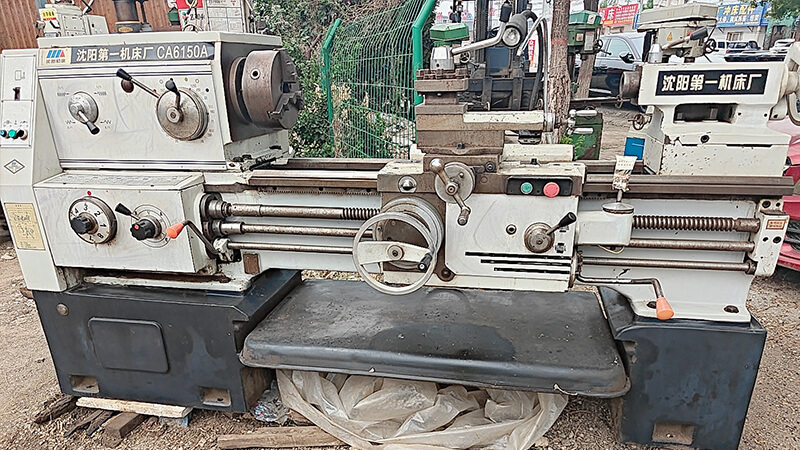
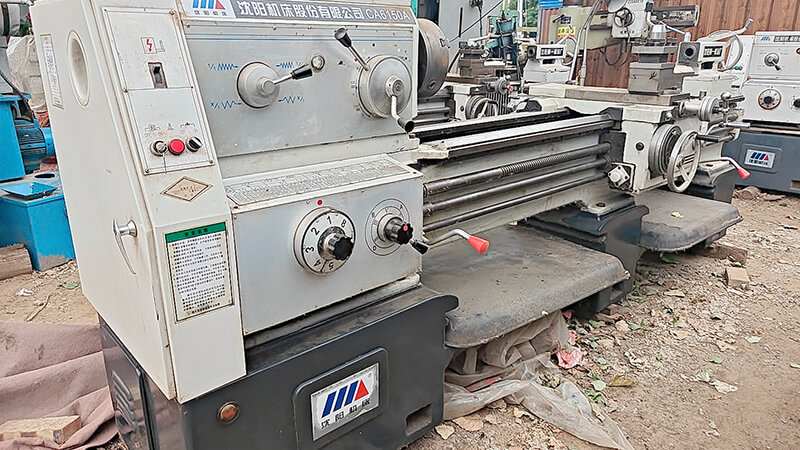
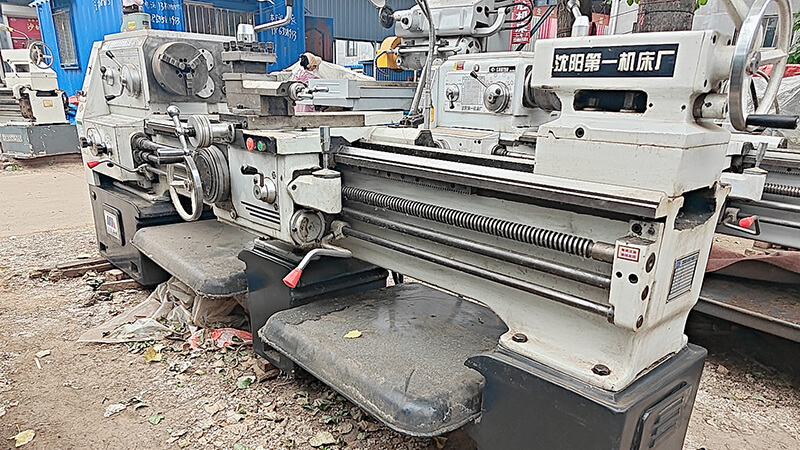
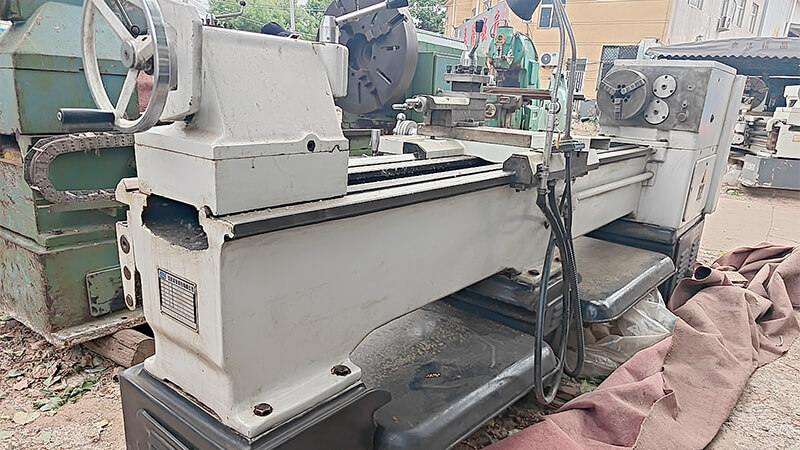

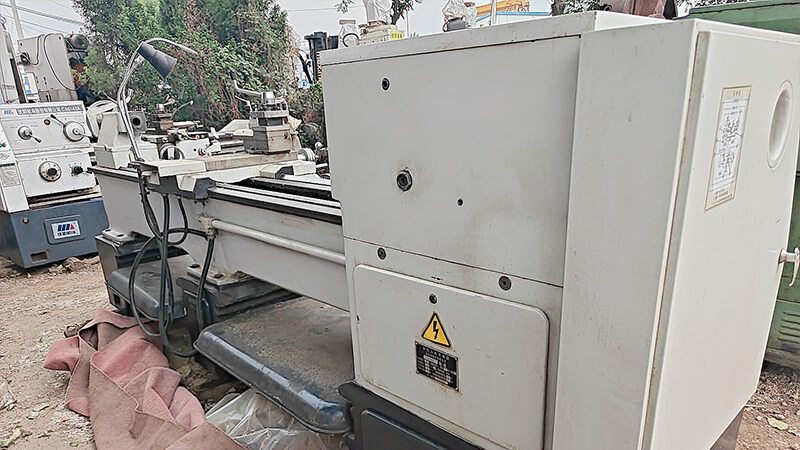
CA6150A Used Lathes
Performance Characteristics
- Strong Processing Capacity: It can turn internal and external cylindrical surfaces, conical surfaces, end faces, various metric, imperial, module and diametral pitch threads, etc. It can also perform operations such as drilling and oil groove drawing, and is suitable for processing various rotating parts.
- Good Machine Rigidity: The bed is wider than ordinary lathes, with a guide rail width of 400mm. It is made of high-strength materials, undergoes natural aging treatment combined with ultra-audio quenching, and the guide rail surface is subjected to medium-frequency quenching, which has high hardness and good wear resistance. It can effectively ensure the high rigidity of the machine tool and guarantee processing accuracy and surface quality.
- User-friendly Operation: The operation is flexible and centralized. The slide plate is equipped with a quick-moving mechanism and adopts a single-handle visualized operation, which reduces the labor intensity of operators and improves work efficiency.
- High Power Utilization: The structural rigidity and transmission rigidity of the machine tool are higher than those of ordinary lathes, with high power utilization. The main motor power is 7.5KW, which is suitable for heavy cutting, can shorten processing time and improve production efficiency.
- High Processing Accuracy: The processing accuracy can reach IT7 grade, the processing surface roughness can reach 3.2, and the accuracy conforms to the national standard of the People’s Republic of China GB/T4020-1997 “Lathe Accuracy Inspection”.
Application Fields
- Mechanical Manufacturing: Used for processing various mechanical parts, such as shafts, discs, sleeves, etc., it is a commonly used processing equipment in the mechanical manufacturing industry.
- Automobile Manufacturing: It can be used to process automobile engine parts, transmission parts, wheel hubs, etc., providing high-precision part support for automobile manufacturing.
- Mold Manufacturing: In mold manufacturing, it can be used to process mold cores, cavities, ejector pins and other parts, ensuring the precision and quality of the molds.
- Aerospace: Used for processing some precision parts in the aerospace field, such as engine blades, shaft parts, etc., which have high requirements on the processing accuracy and surface quality of the parts.
- Maintenance: In equipment maintenance, it can be used to repair worn parts or process some urgently needed spare parts to ensure the normal operation of the equipment.
1,800.00$
Structural Composition
- Headstock: It contains the spindle and speed change mechanism. By changing the meshing position of the gears in the gearbox, the spindle can obtain different rotational speeds.
- Bed: It is the basic component of the lathe, used to support and install other components such as the headstock, feed box, apron, tailstock, etc. There are two parallel guide rails on the bed, which are used to guide the movement of the slide plate and tailstock.
- Feed Box: It contains the speed change mechanism for the feed movement, and can adjust the feed rate and pitch according to processing needs to meet different processing requirements.
- Apron: Connected with the slide plate, it can drive the tool post to move longitudinally or transversely along the bed guide rails to realize feed movement and rapid movement. The apron is equipped with a single-handle operating mechanism, which can conveniently control the movement direction and speed of the tool post.
- Tool Post: Used to install turning tools, it can realize longitudinal, transverse and oblique feed movements of the tools. The tool post usually adopts a four-station turret tool post, which can install four different tools at the same time, improving processing efficiency.
- Tailstock: Installed on the bed guide rails, it can move along the guide rails. It is used to install tools such as centers, drills, reamers, etc., for processing such as drilling and reaming. The position of the tailstock can be adjusted according to processing needs to adapt to the processing of workpieces of different lengths.
- Maintenance
- Daily Maintenance: Before work every day, check the lubrication of all parts of the machine tool and add lubricating oil; clean the dust and chips on the surface of the machine tool to keep it clean; check whether the positions of all operating handles and buttons are correct and whether their actions are sensitive and reliable.
- Regular Maintenance: Regularly check the wear of transmission parts such as guide rails, lead screws, and nuts of the machine tool, and timely adjust or replace severely worn parts; check the electrical system of the machine tool, clean the dust in the electrical cabinet, and fasten the terminals of each electrical component; regularly conduct precision inspection and adjustment of the machine tool to ensure its processing accuracy.
Don’t miss your opportunity-our best machines go fast.
 Request a real-time inspection video
 Send us your requirement list for matching machines
 Need a quote with shipping cost? Contact us now!